



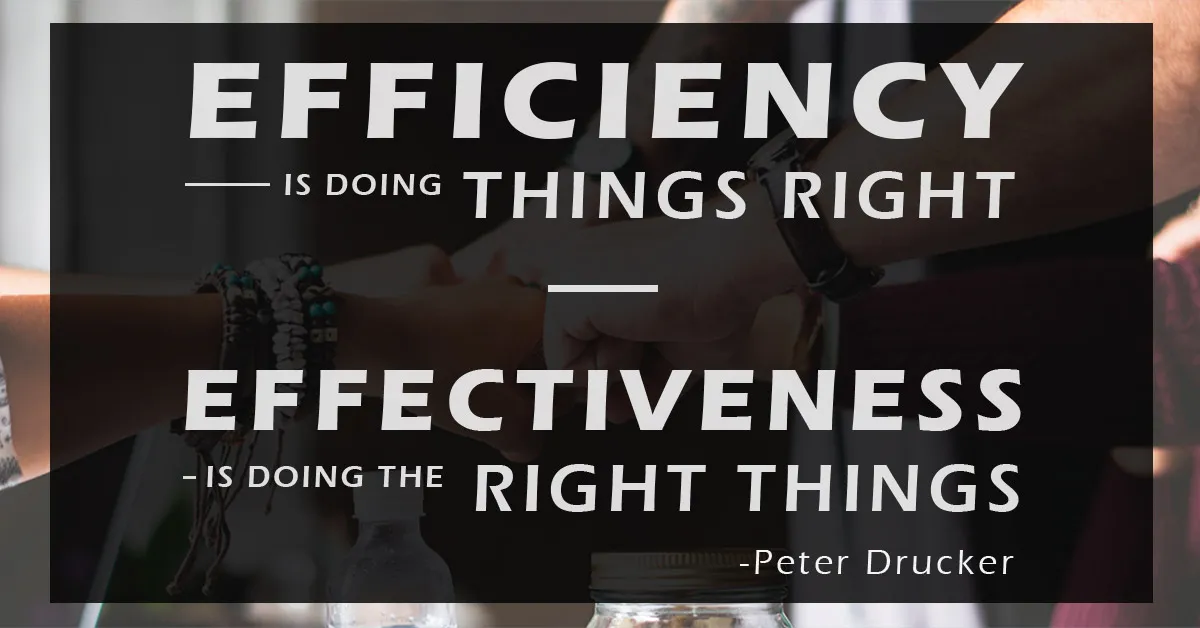
Getting things done isn’t the same as getting the right things done. In an agency, we feel that gap every single day. Client work moves fast, priorities shift by the hour, and it’s easy to confuse busy with effective.
That’s the real problem behind efficiency and effectiveness… they’re not the same thing, and treating them like they are is where the waste creeps in.
Where the waste actually starts
Most of it doesn’t come from people working slowly. It comes from misalignment. Work moving forward on a brief that was never fully confirmed. Effort going toward the loudest request instead of the highest-value one. Nobody’s fault on its own, it’s just what happens when the connection between why and what gets thin.
Some of it isn’t misalignment at all. It’s process that’s outlived its purpose… a check-in nobody remembers the reason for, a sign-off that made sense after one project and never got revisited since. Process at the right level is critical, we need it to move well. The job of a leader is knowing when a process has stopped earning its keep, and retiring it before it quietly becomes the new bottleneck.
What does that look like from the inside?
- Are we solving the client’s actual problem, or reacting to the loudest one?
- Does this week’s work ladder up to something we could explain in one sentence?
- Do we know why, or just what?
- Would everyone on this account describe the goal the same way, if you asked them separately?
- Is this step still earning its place, or is it just how we’ve always done it?
Ask those questions often enough and the pattern gets obvious. The waste isn’t effort, it’s effort spent in a direction nobody agreed on, or an obsolete approach that’s ready to evolve.
It shows up between departments before it ever shows up in the work itself. Leadership sets a direction. Account manages the relationship. The execution team builds the thing. Delivery ships it. If those four aren’t reading from the same page, everyone’s still busy… they’re just busy in four different directions, and the client feels it before we do.
What operational leadership looks like day to day
This isn’t about a bigger plan on a slide. It’s about making sure the people doing the work don’t just hear it, they understand the end goal well enough to feel invested in getting there. Start with the end in mind, and let the day to day work build toward it.
We keep it small, keep it simple. A few things, said clearly, repeated often, beats a thick plan nobody remembers by Wednesday.
- We connect this week’s tasks back to the account’s actual goal, out loud, not assumed.
- Have we explained why before we’ve assigned what?
- We build capability, not dependence… the goal isn’t a team that waits for direction, it’s a team that can spot misalignment on their own and say something.
- Have we revisited our priorities lately, or just defended the ones we set once?
There’s a name for this kind of thinking in lean operations circles… Hoshin Kanri… connecting the top of an organization to the daily work at the bottom, so effort keeps landing on the highest-value thing. You don’t need the term. You need the habit.
None of this happens in one meeting. It’s a rhythm, not an announcement. What mattered at the kickoff has to survive the fourth status call, the client curveball, the week everyone’s underwater. That’s the actual test of operational leadership… not whether it was said once, but whether the highest-value thing is still the thing getting done three weeks later, when nobody’s repeating it out loud anymore.
Efficiency without effectiveness is just speed in the wrong direction. Effectiveness without efficiency burns people out chasing the right goal too slowly. Agencies live or die on getting both at once, and that only happens when the people closest to the work understand what they’re actually working toward.
That’s not a strategy problem. It’s an operational leadership one… and it starts with something as simple as saying why, out loud, more often than feels necessary.